An Interview with Cuban Ambassador Lianys Torres Rivera
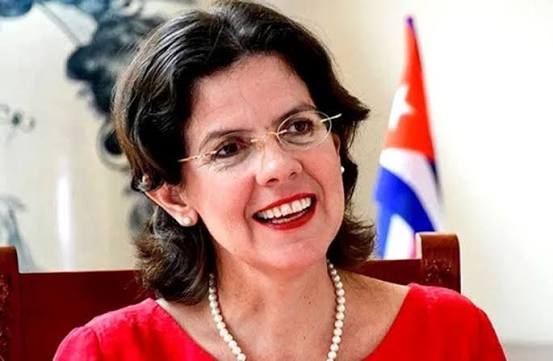 An Interview with Ambassador Lianys Torres Rivera by Katea Stitt, WPFW Program Director
AMB: Well, Katea, thank you for having us today, and I want to also congratulate you and all the American women for the International Women's Day. It's a whole celebration for all women around the world.
KS: Absolutely.
AMB: Thank you so much.
KS: You're quite welcome. And it really is an honor to have you today, and we thank you for taking the time out with us. So, I want to just get right into it, if it's okay with you, Ambassador Torres Rivera. In December of 2014, President Barack Obama and President Raul Castro announced the reestablishment of US-Cuban relations, normalizing relations between the two countries. Presently, we are in a moment that feels quite far away from that historic moment. Please offer an overview of where US-Cuban relations stand right now.
AMB: Well, Katea, the US government has maintained for decades a huge sanction system against Cuba that we call a blockade. It's the oldest, most severe, and comprehensive in the whole world. Those sanctions that are unilateral coercive measures are the pillar of the US policy towards Cuba and have a strong impact on our people and on our economy. With the exemption of the 2-year period from 2015 to 2017 during the Obama administration, we consider that there hasn't been a real will by the US government to improve the relation with, with Cuba. During the Obama administration, Cuba and the US adopted bilateral cooperation instruments, 22 of them, in areas like, for example, law enforcement or environmental conservation, agriculture, public health, and migration, among others. But, and the limited easing of some of those unilateral coercive measures against Cuba increase travel in both ways, in both directions. It also increases the economic, the educational, and cultural, also sport and scientific exchanges between the two peoples. Also created economic opportunities for American individuals and companies in areas like travel or agriculture, health, and the accommodation industry. But during the first terms of President Trump, more than 24 measures were taken and if you— if people can recall, 55 of them in times of COVID with the purpose of suffocating the country economically. We can say that the measures include Cuba's pre-inclusion in the list of state-sponsored terrorism, the possibility to take legal action against companies that do business with Cuba before U.S. courts and file lawsuits under Title III of the so-called Cuba— no, Helms-Burton Act, and the persecution of all of our oil purchases and financial transactions with the resulting obstacles to the supply of basic commodities. When Biden came in in 2021, he kept almost all of the Trump-era sanctions. The very few relief provisions he issued— I mean, his government— were related to travel and remittances, some changes in the regulatory framework of the blockade associated with the private sector, all doing the right direction, but as we said, very limited.
AMB: All of them were very limited. They didn't eliminate or modify the most harmful coercive measures that currently affect the well-being of the Cuban population. And just 6 days before leaving the White House, Biden pulled Cuba out of the SSOT list. Then Trump came in in 2025, and his administration revoked Biden-era executive action that withdrew Cuba from the U.S. SSOT list, and that designation of Cuba as a state sponsor of terrorism, that allegedly state-sponsored terrorism, Carries sanctions that badly impact our economy and therefore the Cuban people's life on a daily basis, worsening, for example, the effects of the blockade, especially in the financial area, because it increases country risk, it discourages tourism, and all that. We can say that this is a policy that does not serve the national interest of the US. And that while this administration has stated they should address the root causes of migration, in the case of Cuba, the effect of our inclusion in the list of states that allegedly sponsor terrorism goes in the very opposite direction. It was also, for example, to establish the list of restricted Cuban entities by which American entities, companies, and individuals are prohibited to conduct any transactions.
AMB: It also has a very extraterritorial scope. It was reactivated the Title 3 of the Helms-Burton Act, and it was suspended all visas for Cubans that want to come to the U.S. for cultural, sports, academic, scientific exchanges. If we go to the last one, that was the executive order that was signed on January 29th of this year, that one tightened the already existing policy of maximum economic pressure against Cuba because it imposed additional tariffs on imports from any country that supplies oil to Cuba directly or indirectly. In order to justify this action, that order says that Cuba poses a threat to the national security of the US. But Cuba, and I want to stress this very firmly, Cuba had never posed a threat to the U.S. We have never been engaged in hostile actions against your country. On the contrary, Cuba is prepared to resume and broaden bilateral cooperation with the U.S. to tackle or to address shared transnational threats while unwaveringly defending our sovereignty and independence.
KS: Thank you, Ambassador Torres Rivera. You've given us both a contemporary and a historical context for what we are seeing right now, and you also mentioned the harm being done from these actions on the part of the U.S. government to the Cuban people. Could you elaborate a bit more specifically or more detailed on what you're seeing right now or hearing about how people are in fact being harmed. What very specific things are happening that are making the lives of the Cuban people increasingly and exponentially more different now in this moment?
AMB: Well, Katea, the US blockade on Cuba has had long-lasting, very effect, very negative effects on the daily life of all Cubans because it limits access to goods and technology for Cuba. It makes very difficult and costly for our country, for example, to import equipment and technology from the U.S. or from companies connected to the U.S. market. For example, we— Cuba cannot buy any product that has more than 10% of U.S. components. Not in the US, not in a third country. And all this has led to shortages of medical supplies, food products, and industrial materials. If we go to the energy sector, it limits our ability to purchase fuel, spare parts, and equipment that are needed to repair, to refurbish our power plants. It has been like that for decades. Many international companies, for example, avoid selling products to Cuba for fear of US sanctions punishment, hindering the maintenance of these plants. Furthermore, it restricts access to international financing and foreign investment that could help improve our energy infrastructure and and develop our renewable energy sources. It also affects, if we go to the healthcare sector, Cuba has a free and universal public health system, but the US unilateral coercive measures have been a severe obstacle for us to buy, for example, medical technologies or medication.
AMB: Or even raw materials for research or production. It established limitations on trade, on travel, and on investment that affect entrepreneurs and academic, but also educative, religious, and scientific and cultural relations. The blockade affects companies and banks of third countries due to the extraterritorial nature of this policy. But if we resume all that, you can say that the effect of the blockade goes to every single area of the Cuban life, of the people, of the Cuban life, the Cuban people. But we have also to say that Cuba is not alone. For many years, the UN overwhelmingly has passed resolution urging the US to lift the blockade. And even in the US, faith organizations, solidarity organizations, scholars, and Cuban associations have also criticized this policy. If you go to Congress, you can count 18 members that have spoken out calling for a resolution to lift recently all unilateral sanctions imposed by the US. And if you allow me, I can say that despite all these challenges and the huge pressure and stress in which our economy has to work, we can say that we have not stood idly. We are moving toward more autonomy, for example, for public companies.
AMB: For our municipalities. We aim for them to import, generate their own export and income from that activity and have more mechanism to invest according to our priority. This year, for example, in food production, we are planning to double the hectares that are planned to, to have rice to 200,000. Probably you saw in the news that we have already in the electricity area installed more than 1,000 megawatts of capacity through photovoltaic parks. We already have around 49 of them. We have gone from 3% to 10% of electricity generation from renewable sources. Which is great, and we are planning to grow almost to 24% by the year 2028. We are installing 5,000 additional photovoltaic sets in essential service centers for the population, for example, like maternity homes, nursing homes, children with special needs that cannot go out of their houses, or polyclinics, or bank branches, and all like that, to tackle with this oil blockade that has been imposed on Cuba since the end of January. Well, that's it.
KS: That's quite a lot. Just to follow up, you've touched on it, but if you could talk a little bit about, despite, as you've mentioned, this blockade, how Cuba continues to excel in a multitude of areas that you've just outlined: literacy, medicine, science, arts and culture, health, etc. All of these being core pillars of the revolution. How do all these areas feed into the resiliency and solidarity modeled by the Cuban people? And I have to say, the resiliency and solidarity that I personally saw when I was in Havana. Could you speak a little bit about that?
AMB: Well, this area has been fundamental in consolidating the Cuban models because they reinforce the principle of equity, solidarity, and social participation that characterized the country since 1959. Our high literacy rates help ensure that all citizens can actively participate in society, understand their rights, and contribute to the collective development. The development of our healthcare system ensures that everyone has access to free medical care. The progress achieved by our country in this sector, as well as in education, has enabled the, the development of solidarity projects between Cuba and other countries. Investment in research, on the other hand, and development has allowed our country to produce our own vaccines. You remember that during COVID we— sorry, we have 5 vaccine candidates, and 3 of them became vaccines. And when we start vaccinating our population with our own vaccines, that was a game changer. Back then that helped later to, to open the country and going back to kind of normal life. But it was, as I said, something that changed her life. We have our own treatment and medical technology for that, demonstrating self-sufficiency and the capacity for innovation in the face of external limitation. Cuba has unique drugs that could be of great importance and will be well received by the US population if we can have the opportunity to bring them on.
AMB: For example, that some for Alzheimer's, to treat Alzheimer's in the early and mild phases of the disease, that has proven to be effective in Cuba, that are on a nasal formulation with very limited side effects. It could be so great that the U.S. could have access to that, and if we have a cooperation between the scientists from both countries. Or for the diabetic foot ulcer, to prevent The amputation, the amputation taken into account the thousands of people in the US that every year go for that traumatic operation, surgical operation. If we go to art and cultures, the culture, the programs related has strengthened in Cuba a national identity and social cohesion. Many people from around the world, but also from the U.S., goes every year for the Jazz Festival, from the International Book Fair, and several other international cultural events that we see them as the way to build bridges between Cuba and the rest of the world, but especially between Cuba and the U.S., because we have so much in common to share and to learn from each other that we should be doing that these years.
KS: If we could just go back a bit because it is incredible that Cuba has maintained this very high literacy rate, one of the highest in the world. Could you talk to our audience about how this occurs and link it to the national literacy campaign that happened, you know, in the beginning of the revolution and how you maintain it today to ensure that this high literacy rate continues.
AMB: Well, Cuba has a near 100% literacy rate thanks to the stay-strong commitment to free public and universal education for the whole population. The origin of this achievement lies in the 1961 National Literacy Campaign, organized shortly after the Cuban Revolution. At that time, many people in rural areas were illiterate, but not also in rural areas, also in the cities. So, the government launched a massive literacy campaign throughout the whole country. The young members of the Conrado Benítez Brigade played a crucial role, and we have in Cuba till today many people that had lived proud of being or having been member of that brigade. Thousands of students back then, many of them between 12 and 18, that probably never went out of their houses, that never were far from their parents, their mother, their grandmother. They traveled to rural communities or to very far areas and live with families while teaching children, because we also had back then many children that didn't know how to write and read. And they teach them that. And thanks to that huge effort, in 1961 we declared the country free of illiteracy. Since then, our government has maintained high literacy levels through free, as I said, free and universal education and universal access to school and ongoing educational programs, programs for others.
AMB: In Cuba, it's free from kindergarten to a PhD. So, you can go kindergarten, primary, secondary, high school, university, master's degree, and PhD for free. And we still have that.
KS: That's just incredible. It's wonderful. And I want to talk to you, if we could go back a moment, to the medical innovation. So, and you mentioned it yourself, during COVID-19, you helped not only Cuba but many countries throughout the, the global south combat this awful disease. Describe why and how medicine is seen as a right and science as a duty, and how do these disciplines fit into Cuba's commitment to global solidarity?
AMB: Well, the Cuban healthcare system remains universal and free, as I said, but due to the strengthening of the US blockade, we have to say that it's under a huge stress that forces us to establish priorities, as everyone can imagine. The hospital system in the whole country continues functioning and providing basic care. However, it has been affected by energy supply resources issues that limit its capacity to, to work properly, and it has affected the normal delivery in general of service. Under the current circumstances, we have prioritized the limited energy that the country has for hospitals. For example, we have installed solar panels, as I said, in polyclinics and have implemented an electrical transportation system for medical staff. For example, in February, last February, many doctors and nurses and medical personnel in general were having serious problems for going to work because of the fuel scarcity that we are facing in the country. Then we implemented this electrical transportation system, mainly in Havana and in most— in the most limited— in a limited version in the rest of the country, but we are expanding it so that doctors can have their own transportation to go to work to do their job. And that is already in place. We have the will, the strong will and commitment of the health personnel in Cuba to keep the functioning of the health system even under this strong stress, as I said, because of the sanctions. And we will continue doing that.
KS: And if we could go back one more time to arts and culture, as I mentioned, I had the honor of visiting Cuba and attending the Havana Jazz Festival, and there were so many international visitors. That's one of the first things I noticed coming specifically for the festival, but more important than that was it was evident that arts and culture permeate every sector. Of Cuban society and are seen as vital to education. Could you describe in a bit more detail how arts and culture contribute to strengthening the country and her people? Because it really is a kind of vibrancy in daily life that you often don't witness in other places.
AMB: You know, we come from Spaniards and Africans. And culture is in our blood, is in our DNA. For Cuban art and culture, we feel that strengthen our country and our people because it has helped to build our identity and our education and social unity. First, art and culture allow Cubans to learn about and value our historical and cultural roots. And through music, dance, and literature, and paintings, our tradition, all of them that are part of our people's identity. And in that way, through culture and music and dance, we transmit all of them., and we do that since we are very little. But furthermore, for us, art fosters our education and critical thinking, and we deeply value that. Many artists in Cuba and writers use their work to express ideas about our society, for example, about our history and daily life. And we think that in that way it helps people reflect on and better understand our reality. But it also strengthens the bonds between our citizens, between the Cuban people, because cultural activities such as festivals or concerts and that kind of events bring the communities together, all the communities together, and that is important to create a sense of belonging and solidarity.
AMB: For example, when you have the Jazz Festival or you have the Havana, the International Havana Book Fair, or the theater international event, you have people that not only come alone, but they bring their families, they bring their children. And the children, since they are very little, we learn from, from where we come from, and we pay tribute to that. If you, if you don't know where you come from, you don't know how, how the future is going to be and how to to build from that. So that's why culture, as I said, is in our blood, is in our DNA, and we build from that.
KS: If I could switch gears here, Cuba is a partner member of BRICS. Could you please illuminate for our audience the significance of this and how membership has impacted the country?
AMB: Well, we have been a partner state We are not a full member, but we are a partner state of BRICS since January 2025. This organization seeks to strengthen economic, political, and financial cooperation among countries of the Global South. When a country is a partner of BRICS, and in the case of Cuba, it’s very important because it opens opportunities for participating in an international space that could lead to international cooperation and trade. And through these relations, Cuba could expand our economic ties with the country that, like, I mean, the one that are members of BRICS. Have large markets and investment and technological capabilities. But Katea, we could say that the relation with BRICS reinforces the idea of that solidarity that is in today's world is most needed among developing countries. And that is something that has been part of our Cuban— of the Cuban foreign policy for decades. So we are grateful of being in that organization.
KS: As we look back, you know, as we mentioned at the beginning of this interview, yesterday was International Women's Day. You all have something called the Cuban Afrofeminist Articulation which works in coordination with the Association for the United Nations in Cuba under President Norma Goicochea. I hope I'm saying her name correctly. It may not be. My pronunciation may be off. But talk to us about the work of the Cuban Afrofeminist Articulation because, as I understand it or it's been explained to me, it really does help to strengthen civic society and help to ensure that people are supported in what they need.
AMB: Well, Norma Goicochea, you say the name okay, you pronounce it (correctly). Thank you. Norma is one of the most experienced ambassadors, Cuban ambassadors, and is someone that everyone loves in the Ministry of Foreign Affairs because she has been always very active and effective defending Cuban foreign policy. You were talking about the Afro-Cuban women, and that is important, but I would like to talk more in a broader way about Pan-Africanism in Cuba, because, you know, this is one of the most beautiful and profound areas of our foreign policy. Because for Cuba, Pan-Africanism is not something like a diplomatic posture. It is a matter, as I said before, of identity and blood. Our relationship with our African sisters and brothers did not begin in 1959. Africa lives in our music, in our spirituality, in our language, but also in our resilience. And we did not go to Africa to help strangers. We go to Africa, we went and we go to Africa to honor a debt that we have of gratitude to our ancestors who are an essential, an essential part of the Cuban nation. When the revolution came to power, Cuba placed itself unconditionally at the service of the African liberation movement.
AMB: And unlike many colonial or others colonial powers, Cuba did not go to Africa seeking gold or diamonds or oil. No, the only remains that we brought back from Africa were those of our combatants who fell in the struggle for that continent's freedom. We can say that thousands of young Africans have graduated in Cuba as doctors, and we say that with proud and in a very humble way, and we are happy to have done that. We have, I mean, engineers that had from Africa and agronomists, for example, that has studied in Cuba in the Latin American School of Medicine. Or even in other faculties. And that Latin American School of Medicine stands as a living monument to practical Pan-Africanism today. Today, currently, thousands of Cuban medical professionals work in dozens of African nations. Combatting, for example, epidemics as they did with Ebola and COVID-19 and strengthening local health systems. And in international forums such as the African Union, Cuba has always received support of our brothers and sisters in African countries that have supported our struggle against the blockade. And we are so grateful, are honored for that, and we deeply value that, Katea.
KS: Finally, Ambassador, could you talk to us about the, the beautiful exhibit that you do at the embassy during Black History Month every year. You host a special exhibit led and curated by photographer and professor Iwan Bagus, and it is— this exhibition is a result of an academic project developed with students from American University and UDC who engage with the works of Cuban and U.S. activists and writers as part of a cross-cultural learning experience. This year The exhibit itself reflects on the writings of Angela Davis and Roberto Fernández Retamar, exploring themes of race, resistance, decolonization, and solidarity. Could you talk to us about this project and the beautiful work that you maintain every year as part of African American History Month there at the embassy in D.C.?
AMB: Yes, you know, our embassy is always trying to, as I said, to build bridges and to bring closer the people from Cuba and the US and to find shared values that we have and to see how we can interconnect each other. And that project is that, is aimed at fulfilling that commitment that we have. And we did it, and people came in, and they were so amazed and happy with the— and surprised with the quality of the painted pictures and the relation that they found between Angela Davis and Ray Tamar, that as you were saying, had many and worked through their life in areas that are common things that we have in our country, in our struggles for independence, for sovereignty, against racism, for the— I mean, for the better life of our people and for the free education, from free healthcare, and all that. We hope that we can continue with this project. We hope that for next year, when we celebrate the African American history, the African American History Month, we could do something like that even bigger. We every year celebrate that. As we celebrate, as I said before, Africa in Our life. That is, and how is it, is a way to pay tribute to what Africans have done for us and to pay tribute to the roots that we have and where we came from. And that exhibition is all that. So as I said, we hope we can continue, we can build bigger in this project. And maybe it's not only with them, but maybe with other universities and with other NGOs and organizations in general from the African American community here in the US. We are ready for that. We are ready for engagement. And you can always count with our embassy if the purpose is, as I said, to bring closer the Cuban people and the U.S. people. That is our job.
KS: Thank you. And just any final words you'd like to share? And I know many of our listeners are activists and really do the work and think deeply about all that you've articulated in this interview. How can our listeners, those of us who believe in justice and liberation and freedom, how can our listeners engage in being in solidarity right now? What are the most important ways in being in solidarity with the Cuban people at this moment?
AMB: Well, what I want to say as a final reflection is that Cuba is a country of peace, a country that welcomes visitors, that wants to engage with any country on Earth, including the US, in having better relations, in complementing each other. We need that because we are neighbors, and we have common threats that we share and that we can be working on to stop them and for the good of our people. So, stay with Cuba. Stay with Cuba. Stay with the Cuban people. And we will never surrender, we will never give up in our sovereignty, in our independence, but we are going through very difficult moments with the strengthening of the sanctions. This is where we are.
KS: Ambassador Lianys Torres Rivera, thank you so very much for spending this time with me and sharing so much about Cuba and the Cuban people. Thank you for sharing your personal resilience and strength as a woman. I am deeply indebted. So we appreciate you and we welcome you back to WPFW anytime and every time.
AMB: Thank you so much. It's been an honor for us to be with you today.
KS: Thank you.